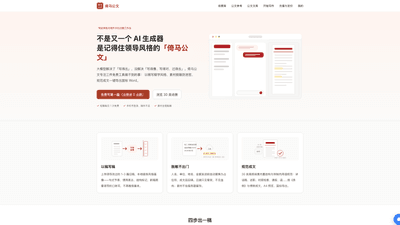
What is it
YiMa Gongwen Scenario Library is an AI-assisted writing platform tailored for official government-style documents. Unlike general-purpose AI writers, it is designed to capture and reproduce a leadership’s distinctive style, ensure factual accuracy, and conform to government document conventions. Key capabilities include learning a leader’s tone from existing drafts, automatic de-identification to protect sensitive information, and one-click export to GB/T 9704-compliant Word documents. The system offers a library of 30 high-frequency scenarios across 9 major categories (speeches, reports, notices, meetings, etc.), with built-in structure and institutional terminology to help you draft quickly and consistently while reducing rework. All data is processed with strict privacy controls: de-identification happens before cloud processing, and materials are not retained on servers beyond your account. This makes YiMa Gongwen a purpose-built tool for internal communications, governance documentation, and standard-operating procedures where accuracy, style, and compliance matter.
Features
- Style-aware drafting that mimics leadership flavor
- Upload 1–3 previous drafts to create a “style portrait,” capturing sentence rhythm, preferred expressions, and structure markers. New drafts are generated to align with the leader’s voice, minimizing rewriting.
- Automatic de-identification and placeholders
- Sensitive information such as names, organizations, locations, and monetary figures are replaced with placeholders before cloud processing. The raw data never leaves your device in identifiable form; the environment preserves confidentiality by replacing content prior to generation.
- Structured, compliant writing workflow
- Four-step process: fill in elements in plain language, automatic de-identification, dialogue-like drafting, and A4 preview. Then export to GB/T 9704-compliant Word with an automatic fact-check checklist.
- 30 scenes across 9 major categories
- Comes with ready-to-use templates for common government-document types: speeches, statements, competition/appointment speeches, reports, work plans, meeting minutes, notices, memos, and party/党建 materials, among others. Each scene includes recommended structure and unit-specific phrasing.
- A4 preview and official export
- View a faithful A4-format preview and export directly to standard Word format aligned with GB/T 9704. Includes in-document guidance to ensure all required sections and order are present.
- Privacy-first data handling
- Materials are not retained on servers after production. You control history: generated documents and inputs live in your account, and you can delete them at any time. The platform emphasizes AI-assisted output, with the user retained as the primary author and decision-maker.
- Free trial and priced token system
- A points-based model lets you pay by usage: 1 point can correspond to a short piece, with longer formats consuming more points. New users receive free points at signup and daily free access to select short-scenario previews.
- Distinct from generic AI
- It’s not a general-purpose Q&A engine; it’s a domain-specific tool that learns a leader’s style and enforces internal conventions, aiming to reduce guesswork and misalignment with institutional norms.
Use cases (scenarios and benefits)
- Leadership speeches and public statements that match a specified leadership style
- Work summaries, performance reviews, and internal reports that adhere to formal structure and terminology
- Conference remarks, briefings, and meeting records that require precise phrasing and compliance
- Official notices and circulation documents with standardized formatting
- Confidential planning or evaluation materials processed with de-identification to protect sensitive data
How to Use
- Step 1: Fill in elements
- Enter the core facts in plain language (topic, audience, purpose, key points, and any mandatory items). The system provides templates for structure and checklists to prevent omissions.
- Step 2: Automatic de-identification
- The tool automatically replaces sensitive entities (names, units, locations, amounts) with placeholders before processing. The cloud view contains only anonymized skeletons.
- Step 3: Dialogue-like drafting
- The platform uses a conversational drafting process: you “chat” with the AI by refining sentences, reorganizing sections, or choosing tone options. You can approve, edit, or request rewrites at any point.
- Step 4: A4 preview and export
- Preview the document in A4 format to confirm layout, headings, and pagination. Then export to a GB/T 9704-compliant Word document, ready for distribution.
- Step 5: Verify with a fact-check checklist
- Each generated document comes with a built-in factual self-check to help ensure accuracy and completeness before final delivery.
- Free and paid access
- Free tier includes the first article and daily access to a short-scenario preview. Paid tiers use a point-based system with clear conversion: each short piece, medium piece, and long piece consumes 1, 2, or 3 points respectively. Points can be purchased via WeChat, and different bundles offer varying value, with benefits like electronic invoicing and free retry on unsatisfactory outputs.
Pricing (points and packages)
- Point system basics
- 1 point ≈ 1 short draft; medium pieces use 2 points; long pieces use 3 points.
- Free signup includes 5 points.
- Daily free attempt for short-scene previews.
- Sample bundles and per-point value
- Starter: ¥14.93 points — about 3 short pieces or 1 long piece; effective price ≈ ¥4.97 per point.
- Popular: ¥44.91 points — about 10 short pieces and 3 long pieces; effective price ≈ ¥4.49 per point.
- Pro/Ultimate: ¥124.93 points — about 30 short pieces and 10 long pieces; effective price ≈ ¥4.16 per point.
- Additional benefits
- Points are valid long-term; electronic invoicing available.
- Free retry if you’re unhappy with a result; non-successful outputs do not deduct points.
- Data and orders are tied to your account; you can switch devices/browsers with the same login to access content.
- Important notes
- Submitting confidential or sensitive information to any online tool is discouraged. YiMa Gongwen emphasizes de-identification and offline handling of sensitive materials to protect privacy.
Tips for maximizing value
- Build a robust “style portrait”
- Regularly upload representative old drafts to refine the leader’s voice and institutional phrasing. The more you feed, the more accurately the system can imitate style.
- Use the 30-scene library strategically
- Start with templates that most closely match your task. As you grow more confident, broaden usage to other scenes to maintain consistency across documents.
- Prioritize de-identification
- Always rely on placeholders for names, places, and figures when preparing content for cloud processing. Refill with real data only after finalizing the draft in a secure environment.
- Leverage the A4 export and checklists
- Use the integrated structure guidance and the GB/T 9704 export to minimize formatting revisions downstream. The fact-check checklist helps catch omissions or inconsistencies before sending.
- Combine with professional review
- Although YiMa Gongwen accelerates drafting, final responsibility remains with you. Use the AI-generated draft as a strong baseline, then adjust or verify against internal standards and factual accuracy.
Frequently Asked Questions
- Is a registration required, and how do I sign in?
- Yes. You must register and verify your phone number on first login. The signup process provides 5 free points. You can log in from different devices with the same phone number; your manuscripts, points, and orders are linked to your account.
- Are my manuscripts safe and stored?
- Manuscripts, points, and orders are stored under your account. You can delete them any time. The service emphasizes de-identification for sensitive materials and does not retain non-identifiable content on external servers beyond your account.
- Is this ghostwriting or AI-generated content?
- It is AI-assisted writing. The output is clearly labeled as AI-generated, and you are the final author responsible for accuracy and use. The tool helps with efficiency but does not replace human judgment.
- Can I upload confidential or classified documents?
- You should avoid uploading confidential or sensitive data. The platform provides de-identification and emphasizes data privacy, but standard best practices require not uploading classified information to any online tool.
- What does “GB/T 9704 Word export” mean?
- It means the tool exports documents in a format aligned with the Chinese national standard for official documents, ensuring consistent structure, style, and layout suitable for formal government use.
- How does the pricing work, and what payment methods are supported?
- Pricing is based on a points system with bundles purchasable via WeChat. Each point corresponds to one unit of drafting effort, with short/medium/long formats consuming 1/2/3 points respectively.
- Can I get support or invoices?
- Yes. Electronic invoicing is available for point purchases, and customer support is typically available for account and usage questions.
- Do I retain ownership of the generated content?
- You retain ownership of the output as the user. The platform provides AI-generated drafts and assistance, but you are responsible for the final content and its appropriate use.
This structured overview highlights YiMa Gongwen Scenario Library as a specialized, privacy-conscious AI writing assistant for official documents. By combining style adaptation, robust de-identification, and GB/T 9704-compliant exports, it aims to reduce drafting time while preserving institutional tone and compliance.